
BLOG
With this summer edition, you'll have a roadmap for your vacation time to learn the basics of being a full-stack data engineer. Fill your knowledge gaps, refresh the basics, or learn with a curated list and path towards a full-time data engineer.
After covering the essential toolkit in Part 1 (essential tools for your machine) and Part 2 (infrastructure and DevOps), this article teaches you how and in what order to learn these skills. The roadmap provides a structured path to level up during the slower summer months.
The roadmap is organized into 3 weeks that you can learn at your own pace and time availability:
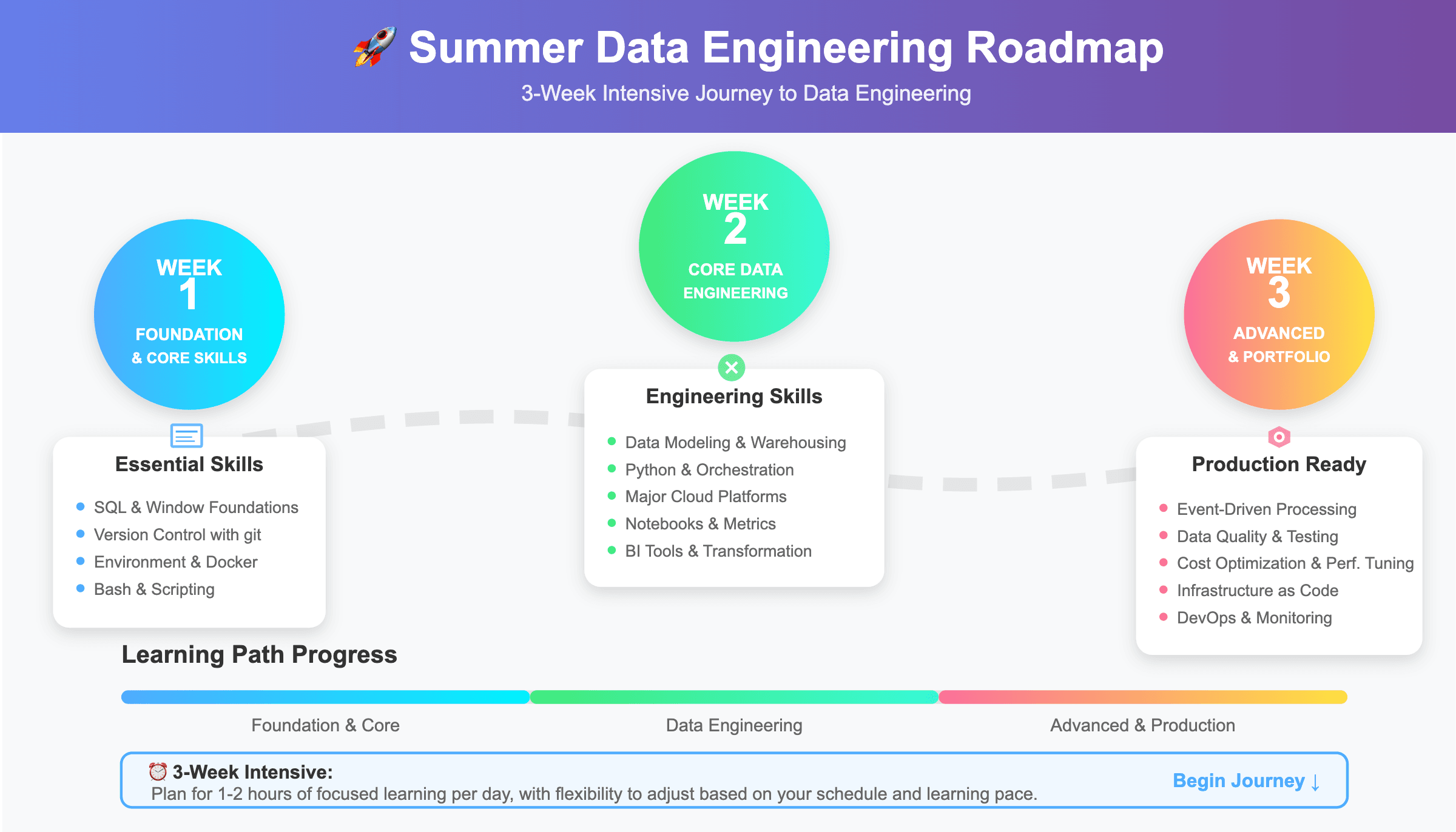
How to use this guide: Each section contains curated resources (articles, videos, tutorials) for that topic. Click on the links that interest you most. It's meant as a guided roadmap to learn the fundamentals of a "full stack" data engineer.
While structured as a three-week program, everyone learns differently. Pick what's most relevant to your goals and skip sections you won't need immediately or in the near-term future. Consistency matters more than speed. Sometimes we forget how far 30 minutes a day can take us. And no, after three weeks, you won't know everything you need to know, but you'll be able to understand the problems and identify potential angles to solve them.
Let's get started with building your technical foundation skills for data engineering.
You can learn the foundational skills in many ways: there are bootcamps, courses, blogs, YouTube videos, hands-on projects, and many more ways to learn them (free and paid ones), including the more advanced skills.
Probably the most important skill of any data engineer, at any level, whether they are closer to the business or more technical, is SQL—the language of data. You can descriptively explain what you want from your data much more precisely than natural language through LLM workflows. That's why it will always be a core skill. For example, in the English language, you won't specify the partitions or the exact date range (including or excluding the current month). There are many questions that you need to define in your WHERE statement or in the SELECT, which you would miss otherwise.
To get started with SQL until you master it, you can follow this roadmap below:
ALTER, CREATE), DML (INSERT, UPDATE, DELETE), and relational theory by Edgar F. Codd, who invented the theoretical basis for relational databases.If you use SQL, very quickly you'll want to work with coworkers and want to version it so as not to lose essential changes or to roll back added bugs.
Therefore, you need version control. This short chapter gives you some starting points for the most common one.
There are many more helpful topics, such as GitHub Actions/Pipelines for CI/CD or basic automation (uploading documents to a website, checking grammar automatically before publishing, etc.). However, for the first week, let's keep it simple and move on to the next chapter: Linux and scripting.
Set up your development environment and master essential Linux skills for data engineering. This depends on your operating system of choice, too, but most data engineering tasks are typically run on servers. In almost all cases, they are executed on Unix-based systems. That's why Linux fundamentals are key to elevating your data engineering skills.
Below are the resources and roadmap to learn about these topics:
Congratulations, this wraps up week one. If you have watched, experimented, and taken notes, you now possess the fundamentals of data engineering and, frankly, any engineering or technical job. Give yourself some time to ponder and review, and then proceed to week two below.
Week two is all about the essential data concepts, primarily established principles for manipulating and architecting data flows for data engineering tasks.
To avoid creating independent SQL queries and persistent data tables without connected data sets, we need to model our data with a more holistic approach.
This is where the concepts of so-called data modeling and the long-standing term data warehousing originate. The sole purpose of these is to organize data optimized for consumption, whereas data in Postgres and other operational databases is optimized for storage.
This chapter will teach you and point you to key knowledge to prepare you to model enterprise workloads.
After SQL, Python is the next most important language to learn. While it's beneficial to have deep knowledge about SQL, and you only need preliminary Linux skills to get around a server and run some commands from the command line, Python is the utility language of data. It's the glue code that connects everything you can't achieve with SQL, most notably working with external systems and orchestrating your data workflows with Python libraries and frameworks.
Orchestration and other more modern tools help you automate and organize, as well as version your data tasks and pipelines.
To manipulate data or create an example project, you can use the provided datasets out of the box with DuckDB: Example Datasets, containing interesting datasets such as HackerNews, Foursquare, PyData, StackOverflow, and many more.
Getting to know major cloud platform providers can save you a significant amount of time and enhance your employability because you know how to work around permissions, the services provided, and how to automate specific tasks. Ensure you select the right provider based on your location and primary use, or the company you prefer to work for.
Depending on where your resume positions you, you'll do different work. But some sort of analytics through business intelligence (BI) is always involved. Visualizing your data and showing it in a way that makes sense immediately is hard; that's where BI tools and data visualization come into play.
This concludes Week Two. You're ready to tackle the advanced topics in Week three.
This final week focuses on advanced topics, including data quality and streaming. This last part of the data engineering roadmap focuses on cost optimization, data quality, event-driven approaches, DevOps learnings, and advanced data quality and observability.
Some of these topics are rarer approaches and should be avoided initially, but there's a time when you need any of them.
Event-driven approaches or integrating your data as a stream, end-to-end from source to your analytics, is sometimes a must and business-critical, especially for ad-tech or sports, where you need live results that are as up-to-date as possible.
Understanding stream processing fundamentals is especially beneficial for validating users' requests for real-time data insights, as they will often ask for it, but it's not always necessary.
Implementing robust data quality frameworks and testing strategies is crucial for maintaining a stable data platform. Most often, it's quick to set up a data platform, or a stack to extract analytics from your data, but doing it stably and with high data quality is an entirely different job. The tools in this chapter will help you with that.
Most of the time, especially if you use cloud solutions, the price to pay for these services is relatively high. Therefore, stopping the creation of a heavy temp table on an hourly basis can save a significant amount of costs. Consequently, it's crucial to debug heavy SQL queries or wasted orchestration tasks, including orphaned ones that aren't connected to any upstream datasets or that aren't in use.
Stacks that don't run in the cloud are optimized differently. Here, you don't pay for cloud services, but to run your own. That's why you optimize for team members and tasks. As data engineering tasks are elaborate, spending time on the right tasks can save a lot of money, too.
In the past, it was referred to as performance tuning. At that time, we were optimizing for speed, which remains the case today. Similarly, if you maximize performance, you also improve cost efficiency at the same time, as it runs for shorter periods. Over time, this can result in significant savings.
Infrastructure management and deploying new software in an automated fashion typically occurs through Infrastructure as Code (IaC) using Kubernetes or a similar platform. That's why it's good to have preliminary knowledge about these tools and when to use them.
That's it. This is a three-week roadmap with numerous courses and links to help you learn data engineering. Let's take a break and dive into the final part, observing what we've learned throughout these three weeks.
This roadmap provides the foundation, but data engineering is a field that requires continuous learning. Stay curious, build projects, and connect with the community. The skills you've developed here will serve as your starting point into more specialized areas as you grow in your career.
A quick recap of what you have learned. By the end of this 3-week roadmap, you should have learned a lot, especially the key components of data engineering. With a little bit of picking and choosing, it should have been fun to engage in new, interesting, and potentially unknown topics.
By Week 1, you learned how to write SQL to query the data you want, and some additional functions that SQL provides that you didn't know before. You know how to safely version control your SQL statements and collaborate with others on them. And you have some basic Linux skills.
After Week 2, you can navigate and use a cloud-based data warehouse on one of the major cloud providers of your choice. You learned different ways to model your data and its flow, as well as which Python libraries and helper frameworks are available.
Week 3 enables you to understand basic analytics skills and present data to clients. You know how to implement the glue code between SQL and run it on Linux using workflow orchestration tools. You have a rough idea of what real-time data workloads look like and how they differ from batch workloads. You should have an understanding of how to package production-ready code for deploying scalable data stacks using DevOps tools and methodologies. You have heard and seen various approaches to architecting an enterprise data platform.
All of it will help you build your portfolio and land your dream data engineering role. Each week builds upon the previous, creating a comprehensive learning experience that mirrors real-world data engineering challenges.
Throughout the entire process, it's beneficial to build your online portfolio, where you showcase your data engineering learnings, Git projects, website, and links to hackathons you participated in, among other things that demonstrate your motivation. Above all, sharing is also fun; people will reach out to you after reading your content, especially if they learn from it too.
Remember to take your time learning new concepts. If you give yourself time to digest, you learn more easily, you'll be able to recall specific terms better, and it's easier to connect the knowledge—this is how our brains learn.
Consistency is key. Dedicate 1-2 hours daily for a couple of weeks, and you'll be amazed at what compounding and consistent learning can achieve.
I hope you enjoyed this write-up. If so, you may also find the essential toolkit article for data engineers, available in Part 1 and Part 2, or check an End-To-End Data Engineering Project with Python and DuckDB.
If you want more? Check out the Mastering Essentials resources by MotherDuck, or follow their YouTube channel for additional resources. If you like DuckDB and need a cost-efficient data warehouse or data engine, check out MotherDuck for free.
Further in-depth content can be found and learned through bootcamps, events, and courses. Please don't give up; it's a lot to take in when you start. Begin with the fundamentals as guided in this roadmap, and also follow your interests. It's better to learn something that might not be suitable right now, but because you are passionate about it, learning comes much more easily. And over time, that knowledge may be put to use at a crucial moment later on.
SQL is fundamental because it's the universal language for data manipulation, supported by virtually every database and data warehouse. Understanding advanced concepts like window functions, CTEs, and query optimization is essential since much of a data engineer's work involves transforming and aggregating data at scale.
A star schema denormalizes dimension tables for faster query performance, making it ideal for most data warehouse use cases. A snowflake schema normalizes dimensions into multiple related tables, reducing storage but requiring more complex joins. Star schemas are generally preferred for OLAP workloads due to simpler queries and better performance.
Modern data infrastructure runs primarily on cloud platforms like AWS, GCP, and Azure. Data engineers need to understand cloud storage (S3, GCS), compute services, and managed data services because most production data pipelines leverage these services for scalability, reliability, and cost efficiency.
A data orchestrator like Airflow, Prefect, or Dagster manages the scheduling, dependencies, and execution of data pipelines. Data engineers need orchestrators to ensure pipelines run reliably at scale, handle failures gracefully, maintain data freshness, and provide visibility into pipeline health and performance.